
Why personalize home decor? Emotional impact & inspiration
Over 70% of homeowners feel more emotionally connected to spaces filled with personalized decor, yet most people still treat their walls and shelves as an afterthought. Home decor is not just about picking colors that match your couch. It shapes how you feel when you walk through the door, how well you sleep, and how deeply you connect with the people you love. This guide walks you through the real science behind personalization, practical methods you can use today, and the stories your home could be telling right now.
Table of Contents
- The emotional science behind personalized home decor
- Storytelling and identity: How decor reflects who you are
- Personalization methods: Mechanics and real-world examples
- Striking the right balance: Avoiding over-personalization
- From nostalgia to care: Special benefits for gifts, families, and seniors
- Market trends and the future: Why personalization is on the rise
- Ready to start personalizing your home?
- Frequently asked questions
Key Takeaways
| Point | Details |
|---|---|
| Boosts emotional connection | Personalized decor strengthens feelings of belonging and satisfaction at home. |
| Tells your unique story | Customizing spaces expresses your family’s history, identity, and values. |
| Improves well-being | Research links personalization to better sleep, lower stress, and happier living. |
| Personalization has limits | Balance personal touches with overall design to avoid clutter and overwhelm. |
| Market is fast-growing | Personalized home decor is in high demand and technology makes it more accessible. |
The emotional science behind personalized home decor
There is a psychological concept called “ownership attachment,” and it explains a lot about why a custom family blanket feels so different from a store-bought throw. When you surround yourself with objects that reflect your identity, your brain registers your home as an extension of yourself. That connection is not just sentimental. It is measurable.
Researchers have found that personalized environments lead to 40% higher home life satisfaction, better sleep, and reduced stress compared to standard, generic spaces. That is a significant difference, and it comes simply from making intentional choices about what surrounds you.
“Your home should tell the story of who you are and be a collection of what you love.” — Nate Berkus
Understanding why personalization matters goes beyond aesthetics. It is about creating an environment where your nervous system can relax because everything around you feels familiar and meaningful. Here is what the research consistently shows:
- Personalized spaces reduce cortisol (the stress hormone) levels after a long day
- Meaningful objects trigger positive memory recall, which boosts mood
- A sense of individuality in your home supports a stronger sense of identity and belonging
- Custom decor encourages pride of place, making you more likely to care for and enjoy your home
When you invest in enhancing your living space with pieces that mean something to you, you are not just decorating. You are building a sanctuary.
Now that you know personalized decor truly affects how you feel at home, let’s explore how it also expresses identity and tells your story.
Storytelling and identity: How decor reflects who you are
Every object in your home is a sentence in a larger story. A framed photo from your grandmother’s kitchen, a canvas print of the city where you met your partner, a metal sign with your family name above the front door. These are not just decorations. They are chapters.
Storytelling via decor turns homes into visual autobiographies, evoking memories and fostering family bonds that generic furniture simply cannot replicate. When guests walk into a personalized home, they learn something real about the people who live there. That is powerful.
Personalization is also deeply tied to values. The items you choose to display communicate what matters to you, whether that is faith, family, adventure, or humor. Here is how people use decor to tell their stories:
- Family milestones: Wedding dates, birth announcements, and anniversary prints mark time in a meaningful way
- Cultural identity: Heirlooms, traditional patterns, and heritage-inspired art connect generations
- Shared experiences: Custom maps, travel photos, and location-based art celebrate places that shaped you
- Personal values: Quotes, mottos, and custom messages reinforce what you believe and how you want to live
Personalized gifts carry this same weight. According to emotional gift research, items that reflect a recipient’s personal story create far deeper emotional impact and are kept significantly longer than generic alternatives.
Pro Tip: When choosing a personalized piece as a gift, think about a specific memory or milestone you share with the recipient. A date, a place, or an inside phrase transforms a beautiful object into something irreplaceable.
Telling your family’s story through decor is powerful, but how exactly do you personalize your space without going overboard? The next section breaks down the methods.
Personalization methods: Mechanics and real-world examples
Personalization does not have to be complicated or expensive. It exists on a spectrum, from simple touches to fully curated rooms. The key is choosing methods that carry genuine meaning rather than just filling space.

Personalization mechanics include monogramming, custom art, family photos, and heirlooms. The methodology behind effective personalization involves curating items for storytelling and emotional resonance, not just visual appeal.
Here is a comparison of meaning-rich versus surface-level personalization:
| Approach | Example | Emotional impact | Long-term value |
|---|---|---|---|
| Meaning-rich | Custom canvas with family names and founding date | Very high | Lasting |
| Meaning-rich | Heirloom display with personal context | Very high | Lasting |
| Surface-level | Generic monogram pillow | Low to moderate | Fades quickly |
| Surface-level | Trendy quote print with no personal tie | Low | Fades quickly |
Here is a simple step-by-step process for adding meaningful personalization to any room:
- Identify your anchor story. What is the most important memory, value, or milestone connected to this room?
- Choose a format that fits the space. Canvas art works well for living rooms; custom blankets suit bedrooms and family rooms.
- Add specific details. Names, dates, locations, and personal messages elevate a piece from decorative to deeply personal.
- Layer thoughtfully. Combine one statement piece with smaller supporting items rather than filling every surface.
- Edit regularly. As your story evolves, so should your decor. Swap out pieces that no longer reflect who you are.
Pro Tip: Start with one room and one anchor piece. Trying to personalize your entire home at once often leads to the clutter and overwhelm we cover in the next section.
Explore personalized decor ideas and practical guides on making your home feel homey to find the right starting point for your space.
You have seen what methods exist, but is there such a thing as too much personalization? Let’s address common pitfalls and best practices.
Striking the right balance: Avoiding over-personalization
More is not always more. One of the most common mistakes people make is treating personalization as a quantity game. The result is a home that feels chaotic rather than curated, and that chaos works against the very emotional benefits you are trying to create.
“A room should feel collected, not decorated.” — Albert Hadley
Over-customization leads to clutter, and clutter is one of the leading contributors to household stress. Balance is essential. Superficial personalization, items that look custom but carry no real meaning, is also far less effective than thoughtful choices.
The data backs this up clearly:
| Approach | 5-year satisfaction rate |
|---|---|
| Thoughtfully customized home | 95% |
| Standard, generic home | 67% |
Custom homeowners report 95% satisfaction after five years compared to just 67% for those in standard homes. The difference is not the quantity of personalized items. It is the quality and intentionality behind them.
Here is how to keep your personalization balanced and effective:
- Choose fewer pieces with deeper meaning over many pieces with shallow connections
- Maintain a consistent visual theme so personalized items feel cohesive, not scattered
- Leave breathing room. Empty space is not wasted space. It lets meaningful pieces stand out
- Revisit your decor seasonally and remove anything that no longer tells your current story
Understanding the importance of balance in personalization helps you maximize impact without sacrificing the calm, welcoming atmosphere that makes a house feel like home.
Understanding balance helps you maximize impact, so how does personalized decor benefit special groups like older adults and the gift market?
From nostalgia to care: Special benefits for gifts, families, and seniors
Personalized decor carries unique power for specific groups. For families, it creates shared identity and gives children a sense of roots. For gift-givers, it transforms a purchase into a memory. For older adults, it can be genuinely therapeutic.
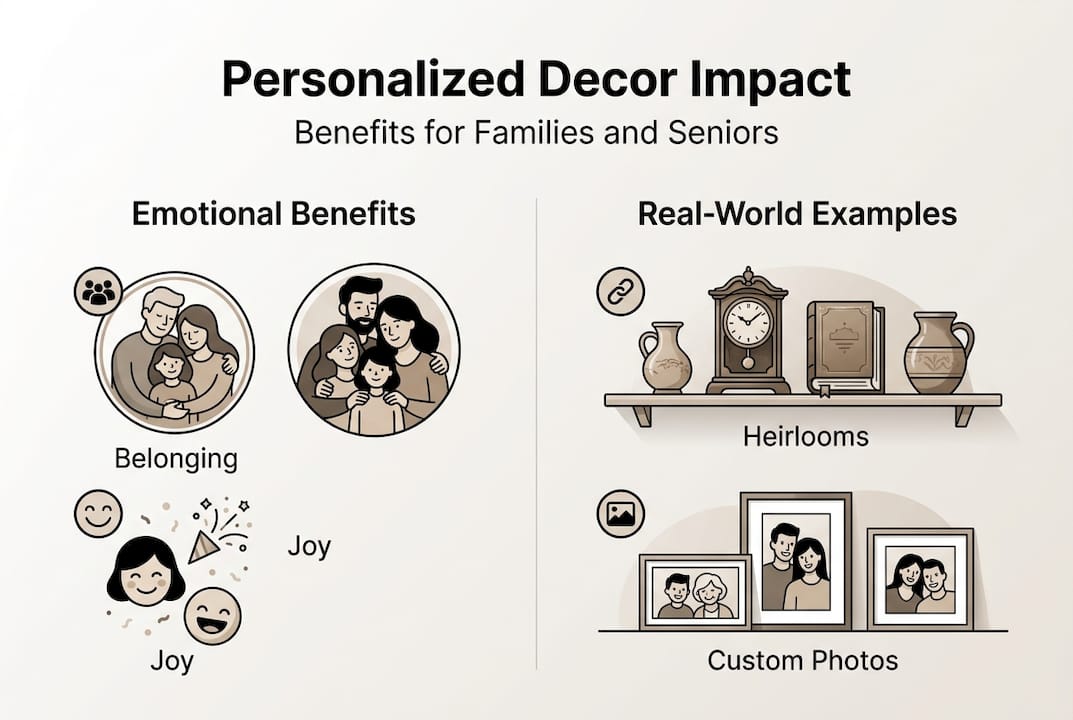
Personalized items create deeper emotional impact and longer retention than generic alternatives, which is why custom gifts consistently outperform standard ones in recipient satisfaction. A blanket printed with a family photo or a canvas featuring a meaningful date is not just a gift. It is a keepsake.
For seniors, the stakes are even higher. Personalized elements evoke nostalgia and a sense of belonging for older adults, though care environments must balance personalization with safety and practicality. Familiar objects, family photos, and meaningful mementos have been shown to reduce anxiety and support cognitive well-being in aging populations.
Here is how personalized decor serves different groups:
- Families: Custom pieces mark milestones and give children a visual sense of family history
- Gift recipients: Personalized gifts are kept longer, displayed more prominently, and recalled more fondly
- Seniors: Familiar, meaningful objects provide comfort, reduce disorientation, and support emotional health
- New homeowners: Personalized accents help a new space feel like home faster
Pro Tip: When gifting personalized decor to an older family member, include a handwritten note explaining the significance of the piece. That context doubles its emotional value.
Explore ideas for personalized gifts and family accents that work beautifully across generations.
Last but not least, let’s look at the big picture: why the world is embracing personalized decor and what’s next.
Market trends and the future: Why personalization is on the rise
Personalized home decor is not a niche trend. It is a booming global market driven by a fundamental human need for self-expression. The personalized home decor market was valued at USD 165.4 billion in 2024 and is projected to reach USD 330.6 billion by 2034, growing at a 7.2% CAGR. That is the market nearly doubling in a decade.
Several forces are driving this growth:
- Rising individualism: People increasingly want their homes to reflect their unique identity, not a catalog template
- E-commerce accessibility: Online platforms make it easier than ever to order custom pieces from anywhere
- New manufacturing technology: 3D printing and digital fabrication allow for affordable, high-quality customization at scale
- Augmented reality tools: AR apps let shoppers preview personalized pieces in their actual rooms before buying
- Gifting culture: The shift toward experiential and meaningful gifts has made personalized decor a top choice for every occasion
The future of personalization is more accessible, more precise, and more emotionally resonant than ever. Explore future personalization trends to stay ahead of what’s coming and find ideas that fit your vision.
Ready to start personalizing your home?
You now have the science, the strategy, and the inspiration. The next step is finding pieces that actually bring your story to life. At FunLifeNow, we specialize in exactly that. Every product we offer, from custom canvas wall art and personalized metal signs to cozy family blankets, is designed to carry meaning, not just fill space.
We are proud to offer American-made products crafted with real attention to quality and detail. Whether you are decorating your own home or searching for a gift that will genuinely move someone, our collections are built around the stories that matter most to you. Browse our personalized decor ideas and inspiration to find your perfect starting point and take the first step toward a home that truly feels like yours.
Frequently asked questions
Does personalized home decor really affect happiness?
Yes. Personalized spaces lead to 40% higher home life satisfaction, better sleep, and measurably less stress compared to generic environments.
What are simple ways to start personalizing my space?
Start with family photos, monogrammed items, custom artwork, or a meaningful heirloom. One anchor piece per room is a great first step.
Is there a risk of making my home too personalized?
Yes. Over-customization creates clutter and reduces visual cohesion, so focus on fewer, more meaningful choices rather than filling every surface.
Why are personalized gifts so popular?
Personalized gifts create stronger emotional impact and are kept and cherished far longer than generic alternatives, making them feel genuinely irreplaceable.
How big is the personalized home decor market?
The market is valued at USD 165.4 billion in 2024 and is projected to reach USD 330.6 billion by 2034, nearly doubling in size over the next decade.